
Once we have latest version, we will send it to your mailbox as soon as possible. our 3V0-21.25 exam questions just need students to spend 20 to 30 hours practicing on the platform which provides simulation problems, can let them have the confidence to pass the 3V0-21.25 exam, so little time great convenience for some workers. Our 3V0-21.25 question torrent not only have reasonable price but also can support practice perfectly, as well as in the update to facilitate instant upgrade for the users in the first place, compared with other education platform on the market, the 3V0-21.25 Exam Question can be said to have high quality performance. It must be your best tool to pass your exam and achieve your target.
| Topic | Details |
|---|---|
| Topic 1 |
|
| Topic 2 |
|
| Topic 3 |
|
| Topic 4 |
|
| Topic 5 |
|
>> Online 3V0-21.25 Bootcamps <<
Would you like to distinguish yourself in IT industry? And would you like to get much more professional recognition? Come on and sign up for VMware 3V0-21.25 Certification Exam to further improve your skills. ValidVCE can help you achieve your wishes. Here has professional knowledge, powerful exam dumps and quality service, which can let you master knowledge and skill with high speed and high efficiency. What's more, it can help you are easy to cross the border and help you access to success.
NEW QUESTION # 22
An administrator has been tasked with creating a provider content library. The following requirements must be satisfied:
* The content library must be configured as a local content library.
* The content library must be associated with the region called West.
Select the four steps involved in configuring the provider content library. (Choose four.)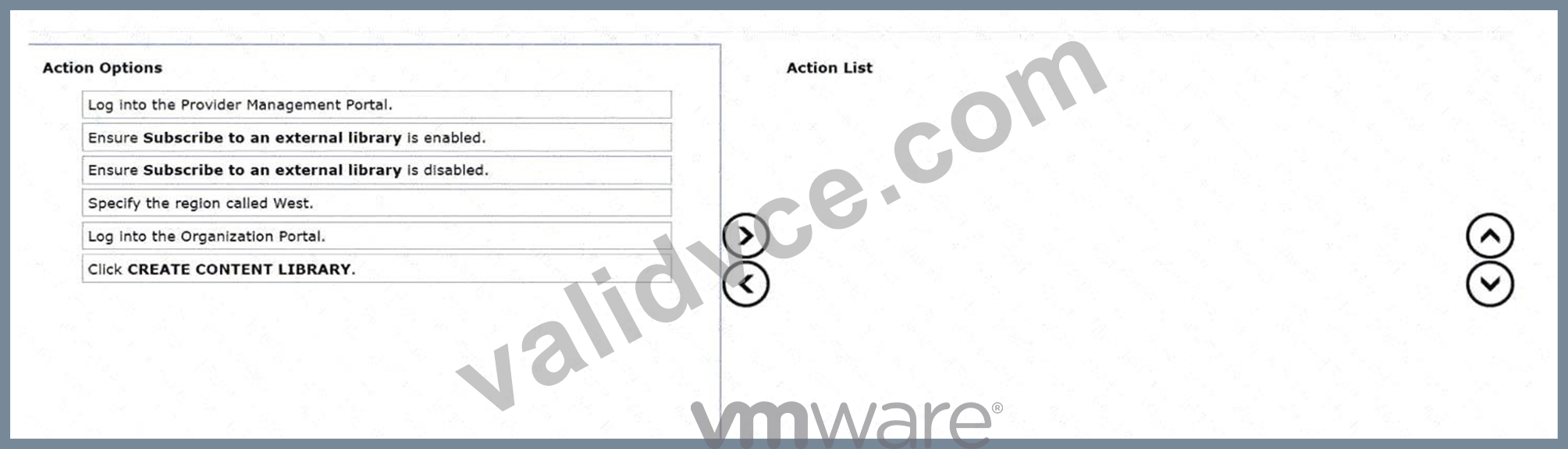
Answer:
Explanation: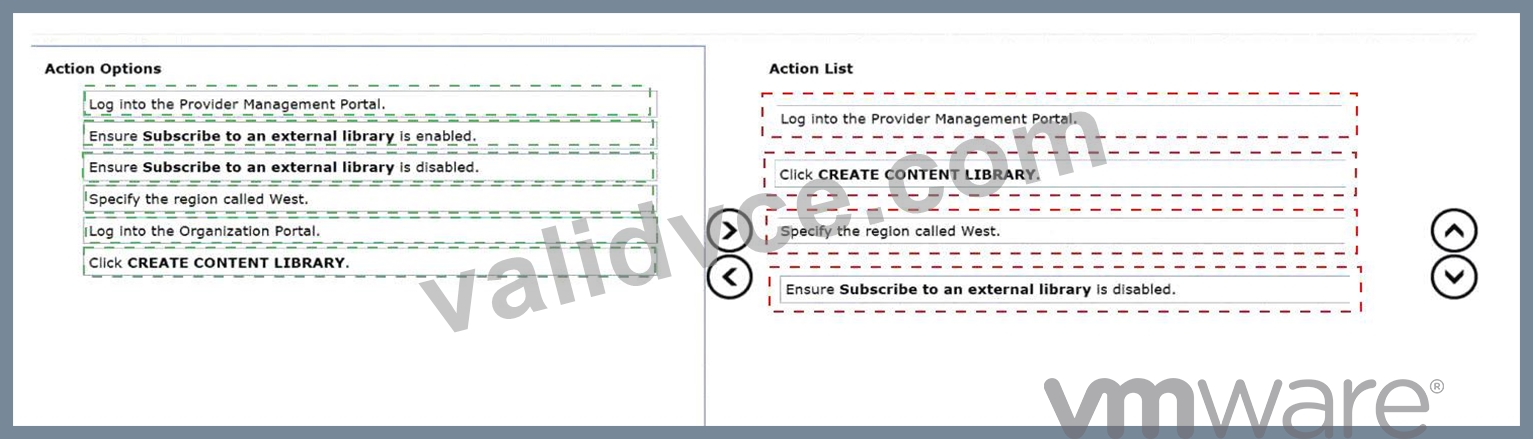
Explanation:
* Log into the Provider Management Portal.
* Click CREATE CONTENT LIBRARY.
* Specify the region called West.
* Ensure Subscribe to an external library is disabled.
In VMware Cloud Foundation (VCF) 9.0, the Provider Management Portal is the centralized interface used by cloud providers to manage global infrastructure and shared resources across the entire fleet.
To satisfy the requirements:
* Administrative Context: The task of creating global resources like a provider-level content library is a
"Day 0/1" infrastructure task, which must be performed in the Provider Management Portal rather than a tenant-specific Organization Portal.
* Regional Association: VCF 9.0 uses Regions to logically group underlying vSphere and NSX resources. Associating the library with the West region ensures that the templates and ISOs within that library are specifically available for workloads deployed into that regional infrastructure.
* Local vs. Subscribed: A Local Content Library is one where the provider directly uploads and manages the content. The requirement specifies a local configuration; therefore, the option to Subscribe to an external library must be disabled. If it were enabled, the library would instead attempt to synchronize content from a remote URL (such as a public VMware repository or another VCF instance).
Once created, this library acts as a "golden repository" that the provider can then share with multiple tenant organizations, ensuring consistency across the private cloud fleet.
NEW QUESTION # 23
A customer requires a backup of blueprints within VMware Cloud Foundation (VCF) Automation to a third- party solution each time the blueprint is released.
What construct will satisfy the requirement?
Answer: C
Explanation:
To automate the export or backup of Blueprints (Cloud Templates) in VCF 9.0, the Event Broker Service (EBS) is the required mechanism. While Velero (Option A) is used for backing up vSphere Pods and ArgoCD (Option C) is for continuous delivery, neither is designed to "listen" for internal automation metadata changes.
By creating an Event Broker Subscription mapped to the "Blueprint Released" or "Template Version Created" topic, the administrator can trigger an action every time a developer finalizes a new version of their infrastructure code. This triggered action (typically an ABX or Orchestrator task) can then programmatically retrieve the YAML definition of the blueprint via the VCF Automation API and push it to an external third- party storage solution or a secondary Git repository for long-term archival and backup. This ensures that the organization maintains a complete, off-appliance history of its infrastructure designs, satisfying auditing and disaster recovery requirements.
NEW QUESTION # 24
An administrator is designing a VCF Automation service catalog item that enables development teams from multiple business units to deploy standardized environments for microservices applications. The solution must support consistent configuration, minimize environment sprawl, and enforce automated decommissioning policies. Which three capabilities of VMware Cloud Foundation (VCF) Automation can be used to meet these requirements? (Choose three.)
Answer: B,C,D
Explanation:
To meet the requirements of a standardized, governed microservices environment, VCF 9.0 Automation provides several key features. First, Lease Policies are the primary tool for minimizing "environment sprawl" and enforcing automated decommissioning. By assigning a lease, the administrator ensures that resources are automatically reclaimed after a set period unless a renewal is explicitly granted, preventing "forgotten" deployments from consuming expensive capacity. Second, cloud-init (or the similar cloudConfig stanza) allows for the standardized, post-deployment configuration of the VM OS, such as installing security agents or company-specific developer tools, ensuring every environment is consistent from "Day 0". Finally, predefined firewall rules (often delivered via NSX VPC Security Profiles) ensure that newly deployed environments adhere to the organization's security standards. This prevents developers from manually (and potentially incorrectly) configuring networking, thereby automating the "Secure-by-Design" requirement within the self-service catalog item.
NEW QUESTION # 25
In VMware Cloud Foundation (VCF) Automation, which construct within an AIIApps organization consists of one or more Supervisors and supplies compute, memory, storage, and network resources to the organization?
Answer: C
Explanation:
In the architectural framework of VCF 9.0's AllApps (AIIApps) organization, the Region is the fundamental resource provider construct. A Region represents a logical grouping of one or more vSphere Supervisor clusters that share a common NSX Manager instance. It is at the Region level that the cloud provider discovers and identifies the available infrastructure capacity-including Kubernetes namespaces, VM classes, and storage policies-that can then be allocated to a tenant organization. When an administrator creates a Region in the Provider Management Portal, they are effectively defining a "pool" of resources that spans physical workload domains, allowing the automation engine to intelligently place workloads across different Supervisors as needed. While a Project is used for user-level resource entitlement and a Cloud Zone is used in the older VMApps model, the Region is the mandatory infrastructure anchor for any modern AIIApps organization seeking to consume Supervisor-based services in VCF 9.0.
NEW QUESTION # 26
A VMware Cloud Foundation (VCF) Automation administrator is creating a new organization for the Product Development team. The developers require self-service networking that allows them to:
* Provision workloads with virtual machines (VMs) and Kubernetes services.
* Attach these workloads to VPCs.
* Customize how ingress and egress traffic is handled.
Which configuration meets the requirement?
Answer: A
Explanation:
To meet the requirement for self-service networking that supports both VMs and Kubernetes (K8s) within a VPC framework, the administrator must deploy an AllApps Organization. In VCF 9.0, the VMApps model is restricted to traditional vSphere-backed networking and does not support the native VPC construct required by the team. By choosing AllApps, the administrator can utilize the Default VPC provided during the Region- to-Organization mapping. This VPC is governed by VPC Connectivity Profiles, which allow the administrator to define how the organization handles traffic-for instance, allowing the development team to manage their own SNAT/DNAT rules and load balancers for ingress control while maintaining the security guardrails set by the provider. This specific combination of the AllApps Organization type and VPC-centric networking is the only way to provide the requested level of flexibility for "modern" developers who need to manage their own application networking stack alongside their containerized and virtualized services.
NEW QUESTION # 27
......
Candidates can also check the explanations for the answers to have more understanding of the VMware 3V0-21.25 questions that are asked on the 3V0-21.25 practice test by ValidVCE You can customize the VMware 3V0-21.25 exam questions and time for the 3V0-21.25 practice exam on the software. Assessing their VMware 3V0-21.25 Exam Preparation and speed on the practice exam software helps candidates in making required improvements and succeeding at the VMware 3V0-21.25 exam. The software by ValidVCE gives the candidates the results and progress reports to help them monitor their performance for the VMware 3V0-21.25 exam.
Reliable 3V0-21.25 Test Voucher: https://www.validvce.com/3V0-21.25-exam-collection.html